Legal Teams Are Using AI and the Work Is Still Piling Up
Legal teams have been buying AI like the software budget is about to expire, but a lot of the actual work still looks painfully familiar.
New research from global law firm Herbert Smith Freehills Kramer found that 81% of more than 500 legal professionals use AI at least once a week, but only 26% use it across a wide range of tasks.
Even among daily users, 57% still rated their skills as intermediate or lower. In plain English, having AI does not mean your legal department suddenly became faster.
If your big transformation plan was “buy licenses, send everyone a login, and pray,” your shiny new software may basically be expensive office furniture.
The timing is rough because Legal is already getting squeezed.
Global legal recruitment firm Taylor Root found that 46.4% of in-house legal professionals said their workload grew significantly over the last two years, while 45.3% said resources did not grow with it.
More than half had already used AI or legal technology to help, yet 44.1% said it had not reduced their reliance on outside counsel.
That leaves a pretty uncomfortable question heading into 2027: if Sales still emails Legal for every contract, employees still struggle to find answers, and lawyers still spend their day pushing routine work around, what exactly did the technology fix?
That adoption problem is where Summize has a useful real-world example.
Edgewell, the global personal care company behind brands like Schick, Banana Boat, Hawaiian Tropic, and Wet Ones, evaluated more than 25 CLM vendors before choosing a system designed to let employees request contracts from Outlook, let Legal work in Word, and keep the process connected instead of forcing everyone into another standalone portal.
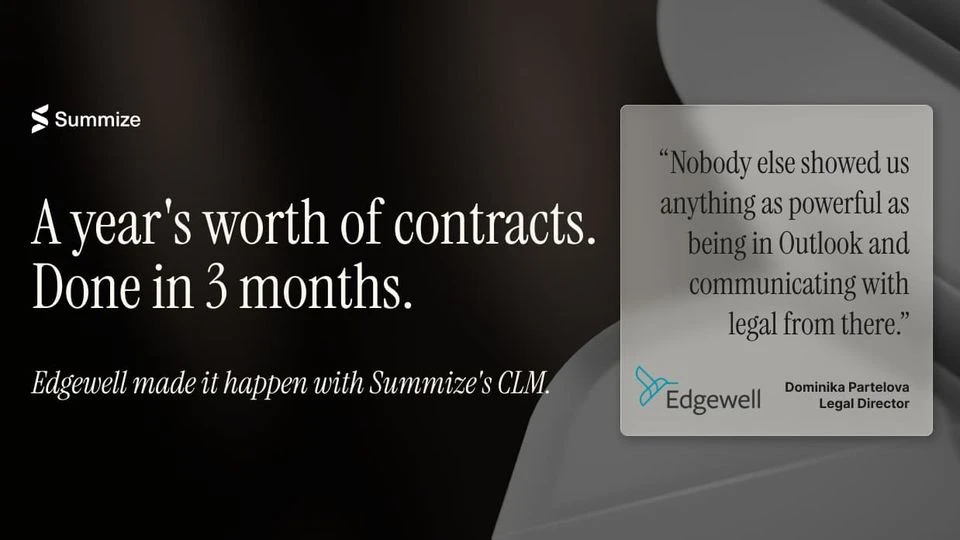
Summize explains how that change helped Edgewell process more than 400 contract requests in three months, roughly what the company previously handled in a year.
How Edgewell Switched to a CLM Its Whole Business Actually Uses

Edgewell had outgrown its first CLM. Complex templates disrupted workflows and the business was still relying on disconnected processes to manage contracts.
Legal Director, Dominika Partelova, assessed 25+ vendors to find a CLM that could better support the business. Summize stood out thanks to our Outlook integration, meaning non-legal users can request and create contracts directly in their inbox via Summize’s plugin.
Now requests move through one connected workflow – the business requests a contract in Outlook, legal redlines in Word and the whole process is visible and trackable in Summize.
The result: 400+ contract requests in three months – the equivalent to a year of contracting with the old system.
With easier-to-access contract processes existing in the tools the whole business uses, Edgewell has improved turnaround times and now gets what it needs from its CLM.
*Sponsored: Clicking ad links might share your email with the sponsor for remarketing purposes.